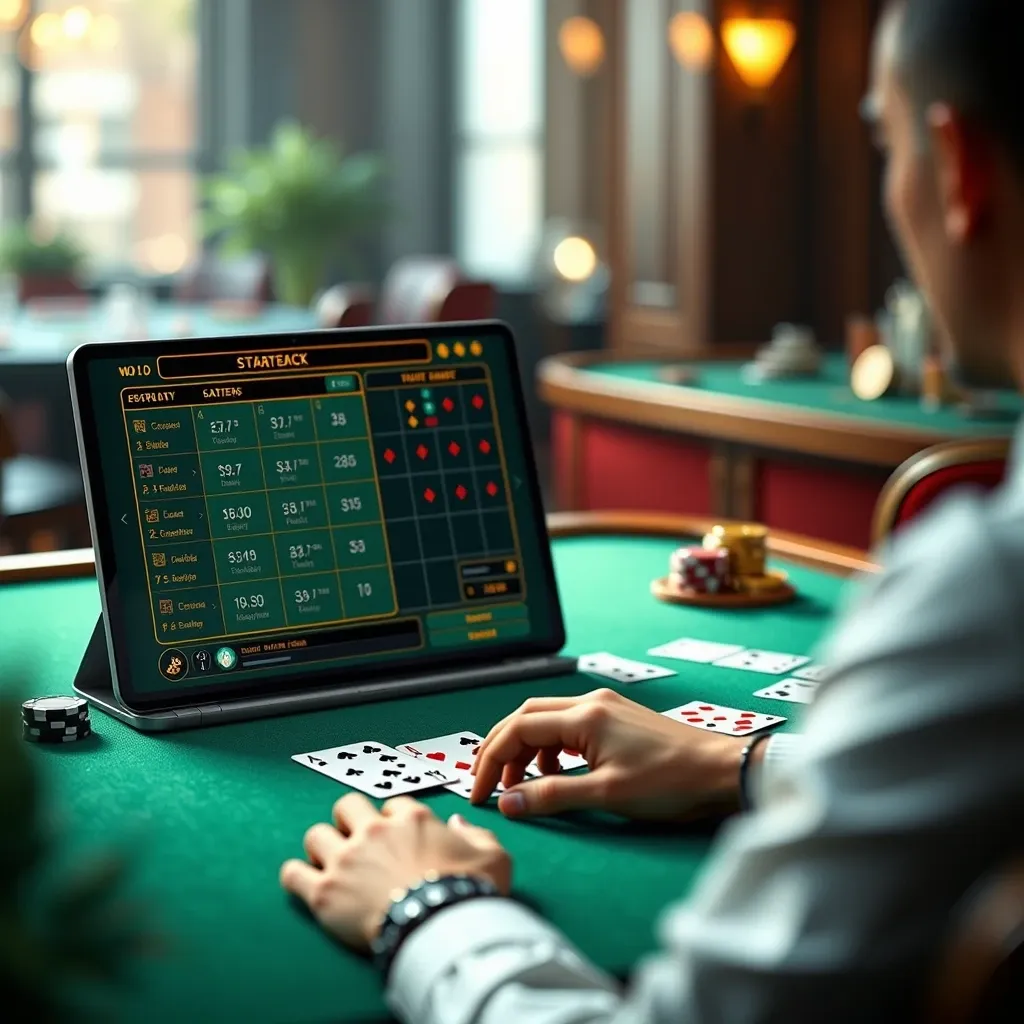
The allure of online blackjack is undeniable. The sleek interface, the quick rounds, and the potential for a big win create an exciting experience right at your fingertips. Many players jump in thinking it’s purely a game of chance. While luck certainly plays a role, a solid blackjack strategy is the key to consistently increasing your odds and minimizing potential losses at the tables.
There is a big difference between blindly hitting and hoping for the best, and making informed decisions based on probability and understanding the game’s mechanics. This article is designed to help you, whether you’re a complete beginner or already familiar with the basics, to elevate your online blackjack game. The objective is to equip everyone with actionable strategies for those looking to make smart decisions, instead of being at the mercy of luck. By having a safer plan, you control your gameplay.
Blackjack has been a passion of mine for years. What started as casual fun quickly evolved into a deep dive into the numbers, probabilities and strategies behind every decision. I’ve spent countless hours studying different approaches, testing them and refining them to develop a balanced way to approach the game, the ability to apply the game with an effective approach to potentially win.
Understanding Basic Blackjack Strategy
Basic blackjack strategy is the bedrock upon which all successful blackjack play is built. Think of it as the game’s instruction manual, but instead of just explaining the rules, it tells you the statistically optimal move in every situation. It’s not about gut feelings or hunches; it’s about making decisions based on mathematically-proven probabilities over the long run. Forget about traditional gambling! Understanding and consistently applying basic strategy is much more akin to following a recipe or using a financial calculator; it transforms your play from a guessing game into a calculated endeavor. I remember when I first started playing blackjack, I was all over the place. Once I committed to learning the basic strategy chart, the change in my win rate was remarkable.
The cornerstone of basic strategy is the blackjack chart. These are readily available online and in many casino gift shops. The chart is a grid, with your hand total listed on one axis and the dealer’s upcard (the card they’re showing) on the other. Where the two intersect, the chart tells you the correct action to take: Hit, Stand, Double Down, or Split Pairs.
Let’s break down some examples. Imagine you have a hand totaling 16, and the dealer is showing a 10. The chart will tell you to Hit. This might feel counterintuitive, as hitting could lead you to bust. However, statistically, hitting is the lesser of two evils in this situation. Conversely, if you have a hard 13 (meaning no Ace that can be counted as 11) and the dealer shows a 6, the chart will advise you to Stand. The dealer is more likely to bust than you are in that spot. Doubling down is another strategic option. Let’s say you hold a hard 11 against a dealer’s 5. The chart screams, “Double Down!” This is because you have a great chance of making a strong hand, and doubling your bet maximizes your potential profit. Finally, splitting pairs, like eights or aces, is another strategically important decision, and the chart provides guidance based on the dealer’s upcard.
The Blackjack Matrix: Reading the Basic Strategy Chart
The blackjack chart, sometimes referred to as a blackjack matrix or strategy table, might seem daunting at first, but getting to grips with it is simpler than you think. Consider this: you are holding a pair of nines (9, 9) and the dealer’s visible card is an 8. Scanning the ‘Pair Splitting’ section of the chart, you would find this scenario and the corresponding action of ‘Split’. This is because splitting gives you a higher probability of winning compared to hitting or standing. Another frequent scenario is the “soft hand,” which includes an Ace counted as 11. For example, holding an Ace and a 6 (soft 17) against a dealer’s 4 typically warrants doubling down, provided the rules allow it. The matrix clearly guides you through these nuanced plays.
Variations in Basic Strategy: Single vs. Multi-Deck
Basic strategy isn’t a one-size-fits-all solution. The number of decks in play significantly impacts the optimal move. Single-deck blackjack generally offers slightly better odds for the player, and the basic strategy chart will reflect this with subtle differences compared to a multi-deck game. For example, certain hands that you would typically hit in a multi-deck game, you might stand with in a single-deck game. Always check which type of game you are playing. A strategy chart designed for a six-deck game will generally lead to incorrect plays in a single-deck game. Therefore, being mindful of the game variation is key to leveraging basic strategy effectively.
Advanced Strategies: Card Counting and Beyond
While basic blackjack strategy provides a solid foundation, some players seek an edge through more advanced techniques. These methods, while complex and demanding, aim to shift the odds, however slightly, in the player’s favor.
One such strategy is card counting. At its core, card counting involves tracking the ratio of high-value cards (10s, face cards, Aces) to low-value cards (2-6) remaining in the deck. By assigning point values to cards (for example, in the Hi-Lo system, high cards are -1, low cards are +1, and 7-9 are 0), players maintain a “running count.” A positive count suggests a higher concentration of high cards, which is advantageous to the player, prompting them to increase their bets. A negative count suggests the opposite, leading them to bet the minimum or even sit out hands.
However, successfully implementing card counting is far from simple. It requires intense concentration, a near-perfect memory, and the ability to quickly calculate and adjust bets. Furthermore, online blackjack presents unique challenges. Most online platforms utilize random number generators (RNGs) to shuffle the deck after each hand, rendering traditional card counting ineffective. Moreover, casinos actively monitor player behavior and may take action against those suspected of card counting. However, some live dealer online casinos, where a human dealer shuffles and deals from a shoe, may offer a limited opportunity for card counting. Players should remember that casinos reserve the right to refuse service to anyone.
Shuffle Tracking: Gaining an Edge After the Shuffle
A more intricate technique is shuffle tracking. This involves attempting to predict where specific groups of cards will end up after the shuffle. This method relies on identifying biases or patterns in the shuffling process, either manual or machine-operated. For instance, if a player observes that a certain section of the deck consistently ends up near the top after a shuffle, they might be able to anticipate the appearance of those cards and adjust their bets accordingly. Shuffle tracking often requires extensive observation and a deep understanding of shuffling procedures. Skilled shuffle trackers might notice subtle irregularities in the dealer’s technique or the mechanics of the shuffling machine.
Team Play: Collaborating to Beat the House
Team play represents another advanced, though often difficult, approach to gaining an edge in blackjack. This involves a team of players working together, often employing card counting and sophisticated signaling techniques. Typically, one or more “spotters” sit at various tables, counting cards and signaling to a “big player” when a table has a favorable count. The big player then joins the table and makes large bets, capitalizing on the advantageous situation. Team play requires significant coordination, trust, and a deep understanding of blackjack strategy. It’s a high-risk, high-reward endeavor that demands discipline and the ability to avoid detection by casino staff.

Bankroll Management for Online Blackjack
Bankroll management is absolutely crucial for online blackjack success. Forget fancy strategies for a moment; without a solid bankroll plan, you’re essentially gambling with reckless abandon. Think of your blackjack bankroll as your business’s operating capital. You wouldn’t run a business without knowing your budget, would you? The same logic applies here. Proper bankroll management protects your funds in the long run, allowing you to weather inevitable losing streaks and capitalize on winning streaks. It’s the foundation of responsible gambling, and honestly, it’s the only way to enjoy blackjack without the constant anxiety of potentially losing everything.
One fundamental rule is to only gamble with what you can afford to lose. This isn’t just some cliché; it’s the bedrock of responsible gambling. Before you even log in to your online casino, decide on a specific amount you’re willing to risk. This amount should be separate from your essential living expenses, savings, and other financial obligations. Consider it entertainment money, like going to a concert or a sporting event. Once that money is gone, you stop. Period.
Next, think about bet sizing. A common recommendation is to bet no more than 1-2% of your total bankroll on any single hand. So, if you have a $500 bankroll, your standard bet should be around $5-$10. This approach minimizes the impact of losing streaks and gives you more opportunities to recover. It also allows you to vary your bets slightly based on the count if you’re using card counting techniques (though be aware that this is often frowned upon by online casinos).
For personal rules, I always set a maximum session time. Time flies when you’re playing, and it’s easy to lose track of how much you’ve spent. I also keep a detailed record of my wins and losses. This helps me identify any patterns in my play and adjust my strategy accordingly. Finally, and perhaps most importantly, I never chase losses. If I hit my stop-loss limit, I walk away. No exceptions.
Setting Win and Loss Limits: Defining Your Boundaries
Establishing clear win and loss limits is a cornerstone of disciplined bankroll management. These limits act as your boundaries, preventing you from getting carried away by euphoria during a winning streak or spiraling into desperation during a losing one. A win limit is the amount you’re aiming to win in a single session. Once you reach that target, you stop playing and cash out. A loss limit is the maximum amount you’re willing to lose in a session. When you hit that limit, you immediately stop playing, regardless of how close you think you are to turning things around.
How do you determine appropriate limits? A common guideline is to set your win limit at 50-100% of your initial bankroll for the session, and your loss limit at 25-50%. So, if you start with $100, your win limit might be $50-$100, and your loss limit might be $25-$50. Adjust these figures based on your risk tolerance and playing style. More aggressive players might opt for higher limits, while more conservative players might prefer lower ones. The key is to find a balance that allows you to enjoy the game without risking significant financial harm. Sticking to these limits requires discipline, but it’s essential for protecting your bankroll and maintaining a healthy relationship with gambling.
Common Mistakes to Avoid
Many online blackjack players, whether novice or seasoned, fall prey to common errors that can significantly impact their odds of winning. Recognizing and avoiding these pitfalls is crucial for improving your gameplay and maximizing your potential returns. Ignoring basic strategy charts is a cardinal sin. These charts provide the mathematically optimal play for every possible hand combination against the dealer’s upcard. Deviating from this strategy, even slightly, increases the house edge. Another frequent mistake is increasing bets when on a losing streak, driven by the hope of quickly recouping losses. This emotional reaction, often referred to as chasing losses, rarely works and can lead to even greater financial setbacks.
Blackjack is a game of skill and focus, so playing when tired, stressed, or emotionally compromised is a recipe for disaster. These states impair decision-making and lead to impulsive bets. Emotional turbulence may cause tilt, which can be avoided by taking breaks, setting loss limits, and recognizing when emotions are clouding judgement. Stepping away from the game allows for a fresh perspective and prevents rash decisions. Understanding the odds, managing bankroll effectively, and maintaining emotional control are fundamental to success in online blackjack.
The Gambler’s Fallacy: Why Past Results Don’t Predict the Future
The Gambler’s Fallacy is a cognitive bias where individuals believe that if something happens more frequently than normal during a given period, it will happen less frequently in the future, or vice versa. In blackjack, this manifests as the belief that a series of losing hands makes a winning hand more likely, or that a dealer’s streak of high cards means low cards are “due.” This is false because each hand in blackjack is an independent event. The cards are shuffled (or randomly generated in online versions), and the outcome of previous hands has absolutely no bearing on the outcome of the next. Every hand presents the same odds, regardless of what has occurred before. Succumbing to the Gambler’s Fallacy can lead to irrational betting decisions and a skewed understanding of the game’s probabilities.

The Future of Blackjack Strategy: AI and Machine Learning
The world of blackjack is on the cusp of a revolution, fueled by the relentless march of artificial intelligence and machine learning. Imagine a future where algorithms dissect millions of blackjack hands, identifying subtle patterns and crafting strategies with unparalleled precision. That future is closer thank one might think.
AI blackjack tools are beginning to emerge, promising to transform the way the game is played. These sophisticated programs sift through mountains of data, far exceeding the capabilities of human analysts. They can pinpoint optimal betting strategies, reveal hidden biases in dealer behavior, and even predict the likelihood of specific card combinations with increasing accuracy. Blackjack analytics is no longer confined to complex spreadsheets; it’s evolving into a dynamic, AI-powered discipline.
The implications are significant for both players and casinos. Skilled players could leverage AI to refine their game and gain a competitive edge. Meanwhile, casinos may need to adapt their strategies to counter AI-driven players and maintain a balanced playing field. Predictive algorithms could become commonplace. As AI continues to evolve, expect the game of blackjack to transform in ways which are at the moment difficult to imagine.
Conclusion
In summary, conquering blackjack hinges on mastering basic strategy, a system honed over countless hours of analysis. Learning these charts and applying them during gameplay massively boosts your odds. But remember, strategy alone isn’t a golden ticket. Smart bankroll management is crucial. Set limits, stick to them, and never chase losses.
Blackjack, when played responsibly, is an exciting game that can deliver both entertainment and potential rewards. So, arm yourself with knowledge, play smart, and most importantly, have fun. The world of blackjack is waiting – are you ready to play?